Top 10 Types of Powder Pressing Machines to Buy?
Choosing the right Powder Pressing Machine is not a simple capacity comparison. Powder behavior, part geometry, tooling life, automation, and powder recovery all affect the final result. A machine that forms a dense gear may perform poorly with a fragile ceramic component. The press frame matters. So does the feed system.
Industry reports show why this decision deserves careful attention. Grand View Research valued the global powder metallurgy market at approximately USD 2.91 billion in 2022, with continued growth projected through 2030. MarketsandMarkets also forecasts strong expansion, driven by automotive, aerospace, medical, and industrial applications. These figures describe the wider powder metallurgy sector, not machines alone. Still, they indicate rising demand for accurate, repeatable compaction equipment.
Randall M. German, a widely recognized powder metallurgy researcher and author, describes the field as “the technology of producing parts from powders.” His point remains practical. Powder pressing depends on controlled pressure, reliable filling, and predictable densification. The best machine is rarely the most powerful one. It is the one that matches your material, tolerances, production volume, and maintenance skills.
This guide compares ten major types of powder pressing machines, including mechanical, hydraulic, servo-driven, rotary, and laboratory models. Some rankings may feel imperfect. They are. A low-cost press can become expensive after repeated tooling adjustments, while a sophisticated system may exceed a small factory’s real needs. Look closely at pressure stability, stroke control, die compatibility, cycle speed, safety systems, and after-sales support before buying.
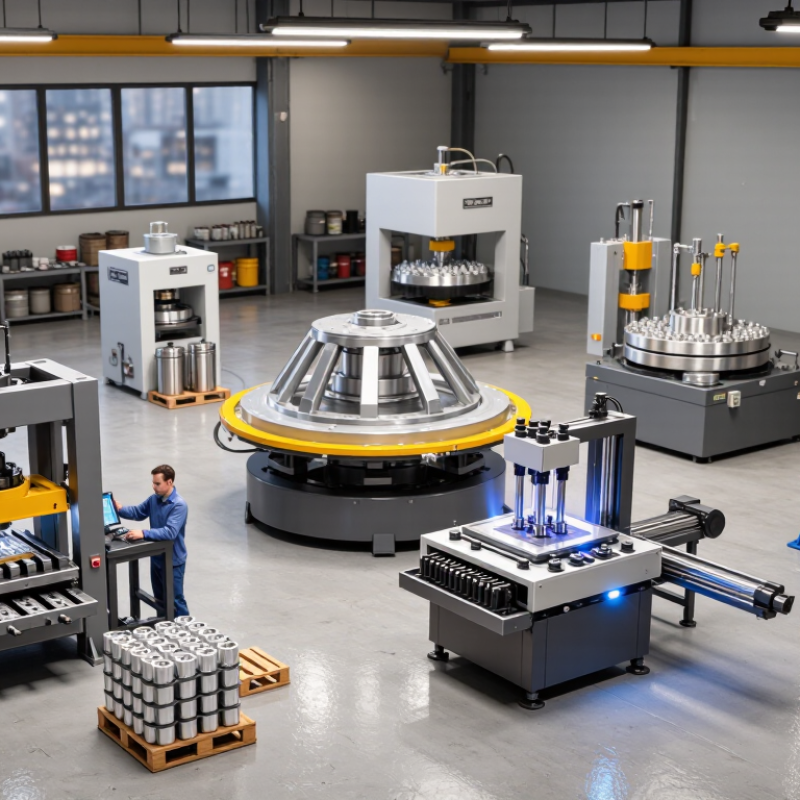
What Is a Powder Pressing Machine and How Does It Work?
A powder pressing machine converts loose powder into a dense, shaped part. It uses controlled force inside a die, usually with an upper punch, lower punch, and filling system. The die defines the part’s width and profile. The punches compress the powder from one or both directions.
The operating cycle is practical but sensitive. A feeder fills the die cavity to a measured height. The upper punch then descends, while the lower punch supports the powder bed. Pressure rearranges particles, reduces air gaps, and creates a compact “green” part. After pressing, the lower punch rises and ejects the compact. Small differences matter. Powder moisture, particle size, lubrication, and filling speed can change density across the part.
Common machine types include hydraulic, mechanical, rotary, eccentric, single-action, double-action, cold isostatic, hot pressing, automatic, and laboratory presses. Each type suits different production demands. Hydraulic systems offer adjustable force and longer dwell time. Mechanical presses can deliver fast, repeatable cycles. Double-action designs often improve density uniformity in taller shapes. Isostatic systems apply pressure more evenly, though tooling and process control become more demanding.
A buyer should inspect force range, die dimensions, stroke control, feeding accuracy, safety guarding, and maintenance access. In practical trials, the first setting rarely works perfectly. A stronger pressing force may improve strength but cause cracking during ejection. That trade-off deserves testing, not guesswork. Surface defects can also reveal uneven filling before equipment failure becomes obvious.
What Are the Top 10 Types of Powder Pressing Machines?
What Are the Top 10 Types of Powder Pressing Machines?
Powder pressing equipment differs by pressure, heating, speed, and part geometry. Grand View Research valued the global powder metallurgy market at about USD 2.9 billion in 2023. It also projects roughly 6.3% annual growth through 2030. That growth increases demand for controlled, repeatable compaction.
The main types include:
1) hydraulic presses for deep, high-force compaction;
2) mechanical presses for fast production;
3) servo-electric presses for precise motion control;
4) rotary tablet presses for continuous small-part output;
5) single-action uniaxial presses for simple shapes;
6) double-action presses for more even density;
7) cold isostatic presses for complex ceramic or metal forms;
8) hot presses combining pressure and heat;
9) roller presses for flakes, sheets, and briquettes; and
10) spark-plasma sintering presses for advanced materials.
Each machine solves a different problem.
Selection should follow the powder’s flowability, target density, tooling design, and required production volume. ASTM B925 testing can help evaluate powder behavior before equipment trials. ISO-based density checks also support process verification. A hydraulic press may create excellent force, yet run too slowly for high-volume work. A rotary machine saves time, but it can expose weak formulation control. In practice, small density variations near corners remain troublesome. The best choice is often the machine that produces stable parts with less adjustment, not the one with the highest rated pressure.
Which Key Features and Specifications Should You Compare?
When buying among the top 10 powder pressing machine types, compare measurable performance, not catalog promises.
Grand View Research valued the global powder metallurgy market at about USD 2.6 billion in 2023. It also forecasts growth above 7% annually through 2030. That expansion increases pressure on manufacturers to improve repeatability and reduce material waste.
Check rated force, usable die area, stroke length, and pressing speed. A 100-ton machine may suit small sintered components, but complex parts often need better force distribution. Compare force-control accuracy, feeder consistency, and density variation across the compact. A practical test should measure powder flow at the actual production rate. Watch the fill shoe. Small surges can create visible density bands.
Energy use matters too. MarketsandMarkets forecasts continued growth in powder metallurgy applications, especially for automotive and industrial components. Therefore, compare motor power, cycle energy, and idle consumption. Hydraulic systems may provide strong peak force, while servo-electric systems can offer cleaner motion control. The choice is not automatic. Review noise, maintenance access, die-change time, and safety interlocks. Ask for data from a test run using your powder, not generic material.
Inspect software records carefully. Useful systems log force, position, fill depth, alarms, and rejected parts. ISO 3252 terminology can help teams compare powder-processing specifications consistently. Yet specifications can mislead. A faster cycle is not better if ejection damages edges or causes sticking. Leave room for trial results, operator feedback, and a few disappointing surprises.
How Can You Choose the Right Powder Pressing Machine to Buy?
Choosing a powder pressing machine starts with the material, not the machine catalogue. Test flowability, moisture, particle size, and compressibility before comparing models.
A hydraulic press suits flexible pressure control and irregular powder behavior. A mechanical press may deliver faster cycles for stable, high-volume production. Rotary presses support multiple stations, but they require careful powder feeding and tablet alignment.
Tips: Request a trial using your actual powder. Check pressure range, die dimensions, output rate, and adjustment accuracy. Ask whether operators can clean contact surfaces without complicated disassembly. Examine safety guards, emergency stops, dust control, and electrical compliance documents. These details often matter more than impressive capacity figures. Measure noise and vibration during a full production cycle, not during a short demonstration.
Your target shape also affects the choice. Simple blocks may need a different tooling system from thin, detailed parts. Confirm whether the machine controls filling depth, compression speed, and ejection force independently. Review maintenance access around punches, seals, sensors, and feeders. A reliable supplier should explain wear limits and provide realistic service intervals.
I once underestimated powder segregation during testing; the final parts showed uneven density. That mistake taught me to inspect cross-sections, not only surface appearance. Leave room for future tooling, but avoid paying for unused force capacity. Small practical checks can prevent expensive production changes.


Fabricator
Inside Sales and Client Support Manager
Glass Handler – 1st Shift